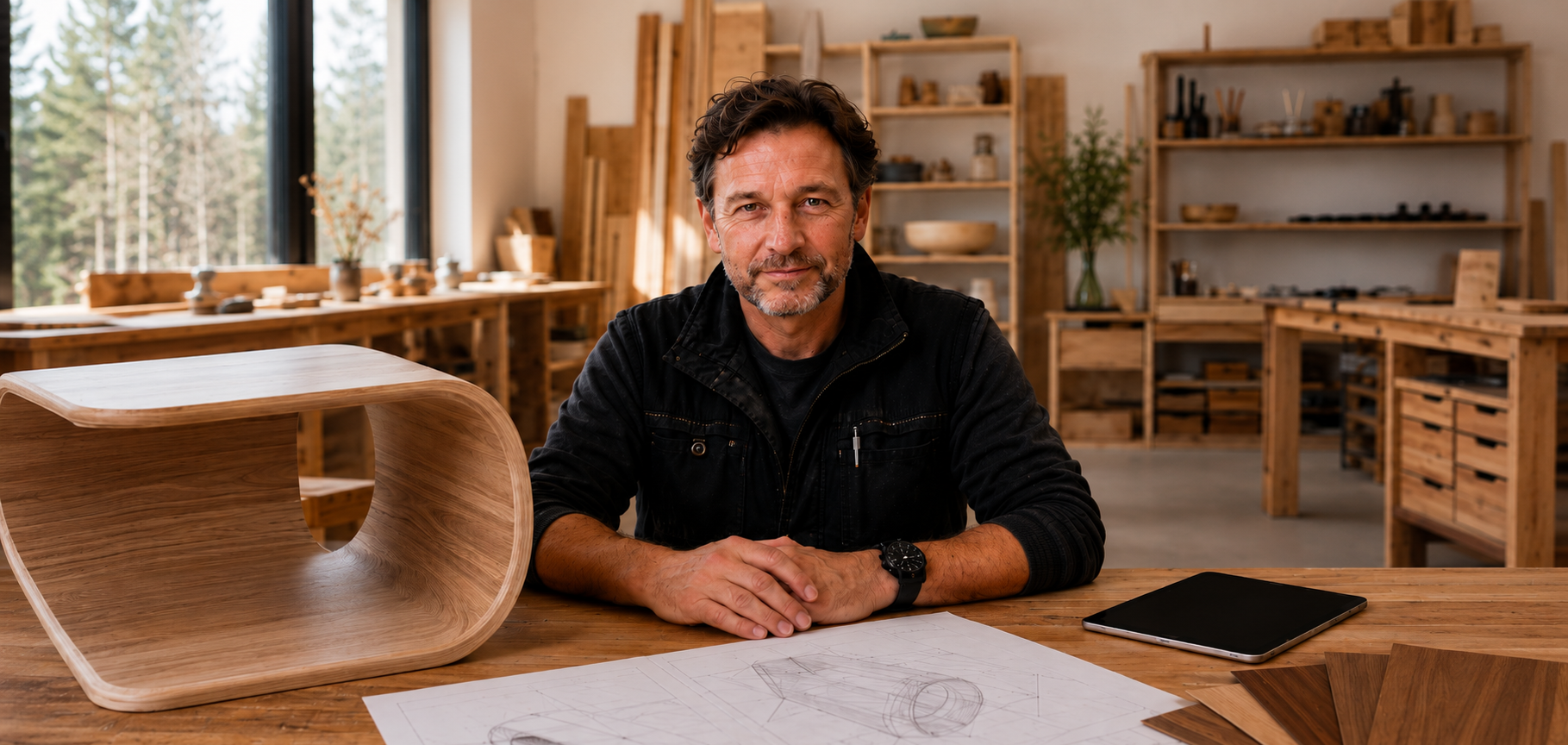
Vacuum Technology FAQ – The 10 most important questions and answers
Vacuum Technology FAQ – The 10 most important questions and answers
▶
Watch the video (AI generated)
Explained briefly in under 90 seconds
Materials and moulding techniques in vacuum applications
The most common practical questions answered by a specialist
#01
How does a vacuum press work?
The physics behind vacuum technology is often misunderstood.
The vacuum pump does not actively ‘pull’ the workpiece together, but rather removes air from the moulding chamber.
This creates a pressure difference:
P = 0.9 bar
The outside air then exerts an even pressure across the entire surface with enormous force.
This means:
- no localised stresses
- no local pressure peaks
- even distribution even with complex shapes
- ideal conditions for veneering, mould gluing and thermoforming
Particularly with organic geometries, this isostatic pressure is significantly superior to mechanical pressing systems.
#02
Why is a vacuum press better than a mechanical press?
Mechanical presses always operate using defined pressure points or linear forces.
A vacuum press, on the other hand, distributes the pressure evenly across the entire surface.
This results in:
- better surface finishes
- less stress
- less springback
- less scrap
- simpler mould construction
In addition, the diaphragm replaces the complex counter-die. This reduces tooling costs and significantly shortens production time.
#03
How long does a membrane last?
The service life of a membrane depends heavily on:
- Temperature
- UV exposure
- Contact with adhesives
- Sharp edges
- Mechanical stress
When used correctly, COLUMBUS specifies a typical service life of:
- approx. 7 years
- or approx. 250,000 pressing cycles
.
The most important measures for extending service life:
- Protection against sharp edges
- Use of felt or absorbent fleece
- Protection against UV radiation
- No direct contact with PUR adhesives
- Correct choice of membrane for temperature ranges
Natural rubber is ideal for veneers and bonding up to approximately 130 °C.
Thermoforming requires high-temperature-resistant silicone membranes that can be used up to 230 °C.
#04
How much pressure does a vacuum actually generate?
Modern vacuum pumps typically achieve:
p = 0.85 to 0.9 bar
This corresponds approximately to:
- 9 t/m²
- 90,000 kg over 10 m²
- evenly distributed across the entire surface
The huge advantage:
The pressure acts everywhere at the same time and automatically adapts to any shape.
#05
Which materials can be processed using vacuum technology?
Modern vacuum technology is extremely versatile.
Materials processed include:
- Veneers
- MDF
- Multiplex
- Plywood
- Acrylic glass
- PMMA
- ABS
- PETG
- Polycarbonate
- Solid surface materials
Typical solid surface materials:
- Corian
- HI-MACS
- Hanex
- Kerrock
The Pioneer modular system from Columbus was developed specifically for professional applications in mould gluing, veneering and thermoforming.
#06
Why do stress cracks or ‘crazing’ occur?
Thermoforming causes stresses to build up in the material.
If these are not relieved in a controlled manner, the following may occur:
- Micro-cracks
- Stress cracks
- Warping
- Springback
Common causes:
- Localised overheating
- Uneven temperature distribution
- Radii that are too small
- Excessive pressure
- Removing the mould too early
Important:
The workpiece must cool down in a controlled manner under constant vacuum.
Rule of thumb:
t = 2 min/mm
for both heating AND cooling times.
#07
Why are ventilation holes and drainage fabric important?
Vacuum technology only works optimally where air can be removed in a controlled manner.
If there is no venting, the following occur:
- air pockets
- incorrect bonding
- uneven pressure
- surface defects
Suction fleece also helps with:
- air distribution
- the movement of the membrane
- membrane protection
- even pressure build-up
#08
Why is it preferable to work with positive (convex) shapes?
Convex shapes allow the membrane to fit naturally without being stretched excessively.
This reduces:
- creasing
- material stress
- membrane wear
- localised overstretching
COLUMBUS therefore strongly recommends:
“Work should always be carried out on convex (positive) shapes.”
#09
Why do professionals opt for dry-running vacuum pumps?
Oil-lubricated pumps produce oil mist and require regular maintenance.
Dry-running pumps offer:
- no oil particles in the workshop
- no surface problems
- lower maintenance costs
- greater production reliability
- lower fire risk
The theoretical pressure advantage of oil-lubricated pumps is of little practical relevance.
That is why COLUMBUS has relied on dry-running Becker high-performance pumps for decades.
#10
What sets COLUMBUS apart from other manufacturers?
Many manufacturers sell machines.
COLUMBUS supplies a complete production system.
This includes:
1. The Master Manual
Over 50 years of practical expertise in:
- Veneering
- Mould gluing
- Thermoforming
- Stencil making
- Error prevention
- Workshop optimisation
The aim:
less waste, faster results and no costly trial and error.
2. The Master GPT
An AI-powered expert assistant designed specifically for the workshop.
Real-time support for:
- Material selection
- Pressing times
- Fault analysis
- Thermoforming
- Adhesive technology
- Membrane selection
- Production optimisation
Multilingual and available at all times.
3. Lifetime warranty
COLUMBUS manufactures in Austria to ISO-certified quality standards.
The machines are:
- solidly built
- modularly expandable
- upgradable in the long term
- designed to last for decades
That is why COLUMBUS offers:
- a lifetime warranty (excluding wear parts)
4. Patented modular system
The Pioneer series can be expanded at any time:
- Pioneer Vertical
- Pioneer Heat
- Silicone membrane systems
- Vacuum tanks
This ensures that the investment remains future-proof in the long term.
Request offer for COLUMBUS 360°
We will be happy to make you an offer exactly for your individual needs!
Thank you for your inquiry!
We will contact you as soon as possible.
We will contact you as soon as possible.
