The ‘Curved Design’ Boom: Why Organic Shapes Are Now Dominating the Furniture Market
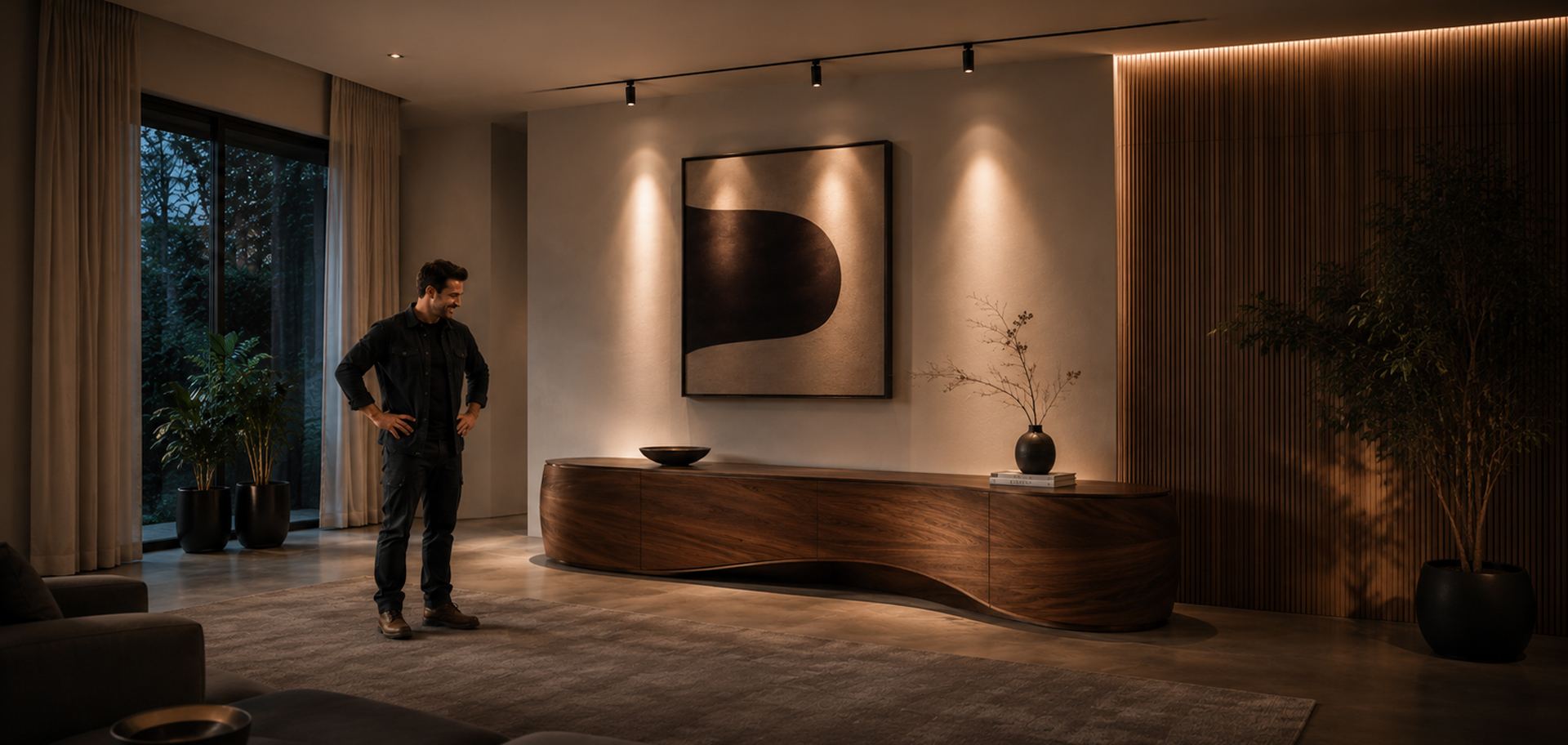
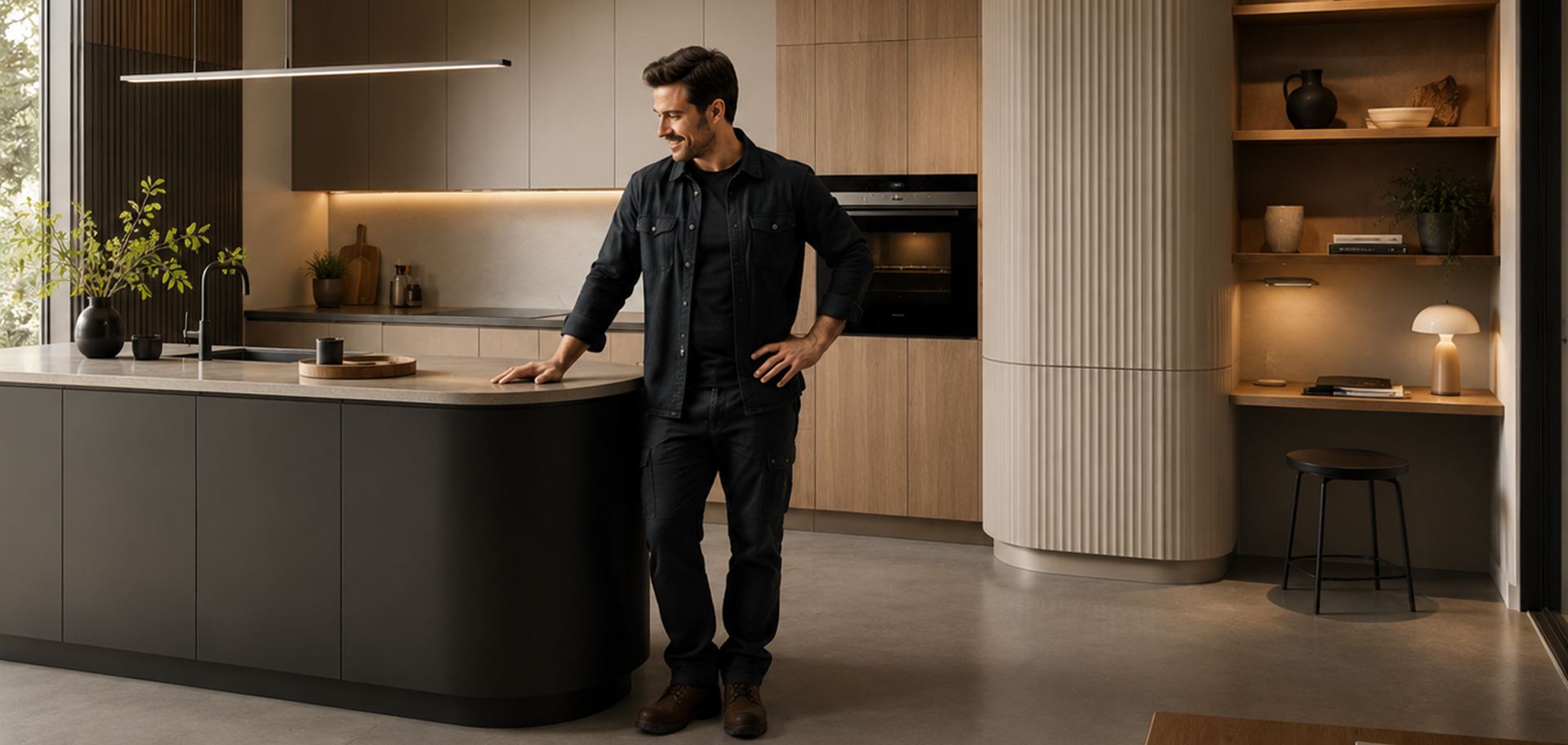
After decades of minimalism and sharp, right angles dominating the scene, the world of interior design is currently undergoing a seismic shift. ‘Curved design’ is no longer just a niche for avant-garde designers, but has conquered the mass market for high-quality furnishings worldwide. Organic shapes, gentle curves and flowing silhouettes convey a sense of comfort and naturalness that customers crave in an increasingly technologised world. Whether curved kitchen islands, rounded sideboards or circular reception desks – demand for anything that isn’t angular is rising rapidly.
The psychological factor and the market opportunity
Studies in residential psychology show that the human brain reacts positively to curves; they are perceived as less threatening and more harmonious than sharp edges. For joinery workshops and furniture manufacturers, however, this trend often presents a technical hurdle. Many businesses shy away from complex curves, as traditional production methods involving substantial material allowances and heavy-duty pressing equipment seem unprofitable. Yet this is precisely where the profit margin lies: whilst the market for ‘flat’ standard furniture is extremely price-competitive, premium prices can be achieved for masterfully crafted, organic one-off pieces. In this scenario, the
vacuum press is the technological game-changer that enables the transition from standard craftsmanship to high-end design.
Expert insight: “We are seeing worldwide that customers are willing to pay up to 30% more for a piece of furniture with a 100 mm radius than for the angular version. The reason is the perceived exclusivity. With a vacuum press, however, your internal effort for this radius drops to almost zero, as the vacuum takes care of the physics for you, rather than you having to invest hours in building press jigs.”
Counterintuitive tip: Don’t try to follow the trend by laboriously gluing together solid wood segments. This often leads to stress cracks. Instead, use vacuum-assisted laminating. It is more stable, faster and makes optimal use of the properties of modern materials, without the piece of furniture ‘working’ and warping later on.
Key Takeaway: The trend towards organic forms (curved design) offers enormous opportunities for growth and profit margins. The vacuum press is the crucial tool for turning this aesthetic vision into reality without the massive costs associated with traditional mould gluing methods.
Cost-effective mould gluing: How the vacuum press eliminates expensive templates and failed attempts
With traditional mould gluing, the effort involved is often frustrating: for every curve, not only must the actual mould (the die) be built, but also a precisely matching counterpart (the patrix) to distribute the pressure evenly. A tiny calculation error in the radius or a small foreign object between the templates inevitably leads to pressure marks or air pockets in the workpiece. Anyone using a
vacuum press simply eliminates this economic risk.
The single-template revolution
The vacuum principle makes the male mould (the counterpart) completely redundant. The highly flexible membrane of the vacuum press applies the full atmospheric pressure of around 9 tonnes per square metre across the workpiece and the template. In doing so, it adapts perfectly to every contour – no matter how complex. For the business, this means: 50% less time spent on template construction and 100% material savings on the counter-mould. In a modern cost calculation, where skilled labour is the most expensive component, the machine often pays for itself after just a few complex jobs.
Precision instead of ‘trial and error’
Another critical point is the error rate. Mechanical presses operate with point pressure. If the angle is not hit exactly, the layers shift during the pressing process (the notorious ‘floating effect’). In the vacuum, on the other hand, the air is evacuated evenly, which fixes the layers in place before full pressure is built up. The result is a level of repeatability that is virtually impossible to achieve with manual clamps or hydraulic stamps. This is particularly important in the mass production of trendy furniture, where every part must be identical.
Expert insight: “The biggest time-waster in the workshop is ‘tinkering’ with shims for curves. I always tell my customers: Stop tinkering, start pressing. With the vacuum press, the template becomes a simple base. We have seen companies that have reduced their set-up times for curved components from four hours to 20 minutes – simply because there is no need to search for and adjust counter-moulds.”
Counterintuitive tip: Use inexpensive materials such as MDF offcuts for template construction using the vacuum method. As the membrane applies pressure from above, the template merely needs to be dimensionally stable, rather than having to withstand mechanical point loads weighing tonnes, as is the case with a hydraulic press. This saves on material costs as well.
Key Takeaway: The vacuum press makes mould gluing cost-effective by eliminating the need for a counter-mould (patrix). This massively reduces set-up times and material costs in template construction whilst simultaneously eliminating typical pressing errors through omnidirectional pressure.
Veneering on radii: Perfect surfaces for complex geometries – stress-free
Veneering flat panels is standard practice, but as soon as a radius comes into play, stress levels in the workshop rise. With conventional pressing methods, there is a massive risk of veneer cracks, glue bleed-through or the dreaded ‘furrier’s marks’ (air pockets) on curved surfaces. Anyone working with the
vacuum press will find that veneering organic shapes is physically even cleaner than on flat surfaces.
Omnidirectional pressure as a guarantee of quality
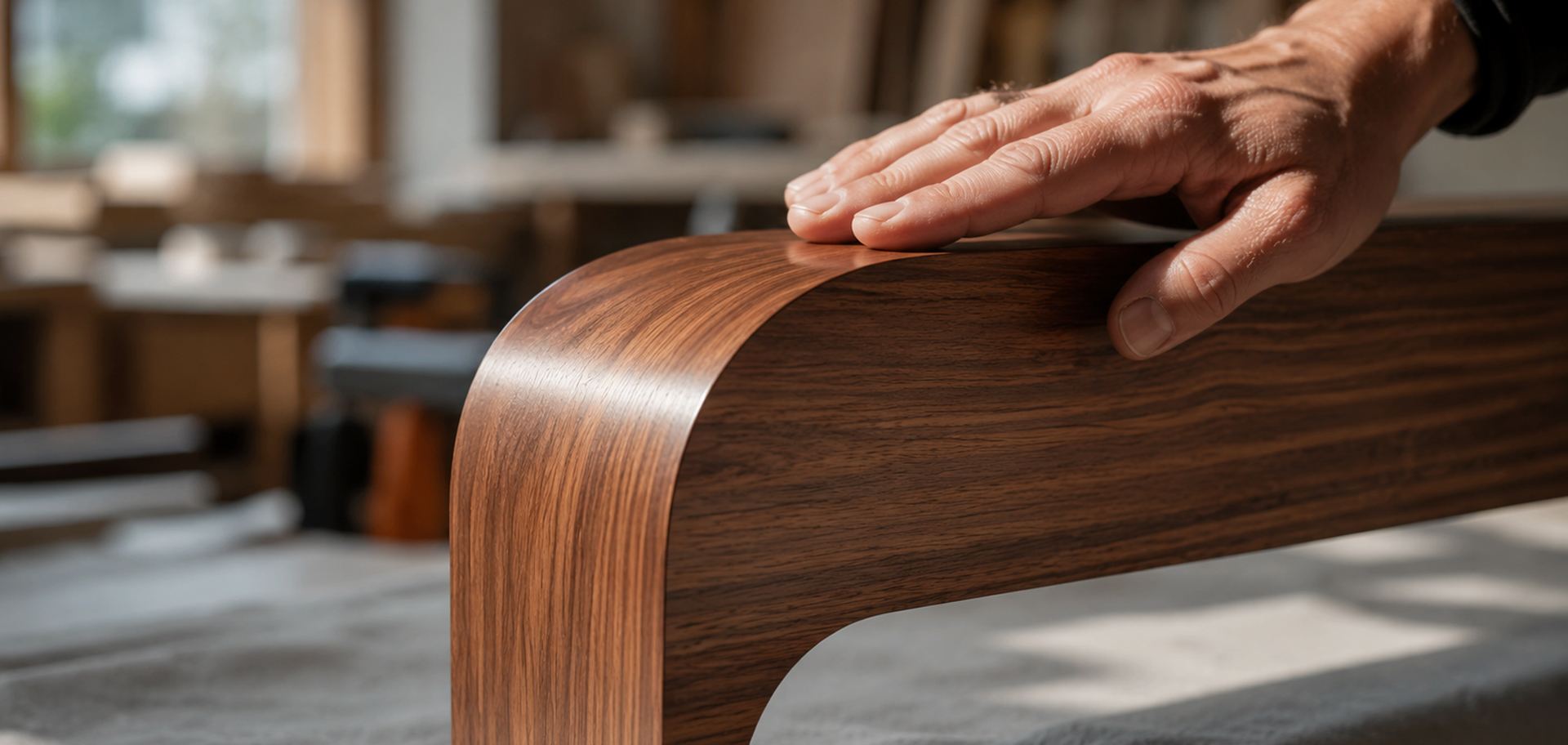
The key advantage of the vacuum press is that the pressure does not just come from above (vertically), but acts perpendicular to every point on the surface – regardless of the angle at which it is positioned. Whilst a mechanical press often loses pressure at the edges of a curve, the vacuum presses the veneer with constant force even into tight radii and undercuts. This prevents the veneer from lifting slightly or coming under tension during the drying phase, which could later lead to cracks.
Prevention of surface defects
A counterintuitive advantage of the vacuum is pore management. As the air is evacuated from the press before full pressure is built up, air pockets beneath the veneer are also drawn out. The risk of glue bleed-through is minimised, as atmospheric pressure presses the glue evenly into the substrate panel rather than forcing it outwards through the veneer’s capillaries. For modern, trendy furniture, which is often designed with extremely thin or open-pore fine veneers, there is no alternative to this gentle yet precise process.
Counterintuitive tip: For very tight radii, use a special fleece between the membrane and the veneer. This ensures even better venting and prevents the slightest unevenness in the membrane from being transferred to highly sensitive high-gloss veneers.
Key Takeaway: The vacuum press guarantees flawless surfaces on curved surfaces through omnidirectional pressure. It eliminates air pockets and stress cracks by physically pressing the veneer evenly against every contour, which leads to superior results, particularly with high-quality veneers.
Material versatility in the vacuum: From bent plywood to solid surface – one tool for everything
The trend towards organic forms does not stop at the choice of material. Whilst classic veneer presses are limited to wood-based materials, the
vacuum press is a technological chameleon. It enables companies to combine and shape materials that would simply be destroyed in a rigid hydraulic press or, due to their nature, could not be pressed at all. This is the decisive factor in positioning oneself as a modern solution provider for architects and discerning private clients.
Synergy of materials: high-end composite construction
Modern curves are often achieved today using a layered construction. The vacuum press allows the simultaneous bonding of bent plywood, thin MDF boards (such as Topan) and fine face veneers in a single operation. But the possibilities extend far beyond wood: the thermoforming of solid surface materials for seamless, curved bathroom and kitchen designs is easily achievable with a vacuum press and a suitable heating station. Modern composites or linoleum can also be gently and precisely moulded around curves using the vacuum process without damaging the tactile surface.
Protection of sensitive surfaces
A frequently underestimated aspect when using trendy materials is their sensitivity. High-gloss laminates or solid-coloured materials react adversely to the hard, localised pressure of mechanical clamps or steel plates. The elastic membrane of the vacuum press, on the other hand, acts as a protective intermediate layer that distributes the pressure absolutely evenly. This prevents the formation of shiny spots or indentations, reducing rework (and thus costs) to virtually zero.
Expert insight: “In modern contract interiors, we are seeing material mixes more and more frequently – for example, a leather-upholstered, curved sideboard or acoustic panels with extremely tight radii. Anyone working with traditional methods here risks producing rejects. The vacuum press is the only tool capable of handling the varying compressibility of these materials, because the vacuum follows the path of least resistance and presses everything precisely to the shape.”
Counterintuitive tip: Think beyond wood! Use your vacuum press to laminate acoustic felts or textiles onto curved substrate panels. Atmospheric pressure ensures such a homogeneous bond that the adhesive spreads perfectly without bleeding through the fabric – a problem that almost always occurs with manual pressing.
Key Takeaway: The vacuum press is a multi-material tool. It not only enables the mould gluing of wood, but also the thermoforming of solid surface materials and the lamination of delicate materials such as leather or textiles onto complex radii, which massively increases the technological value added by the business.
The business case: Why the trend towards curves means that the investment in vacuum technology pays for itself faster than ever before
In the current market environment, the decision to invest in a
vacuum press is not merely the purchase of another tool, but a strategic reorientation of the business model. Whilst margins in traditional, linear furniture manufacturing are coming under pressure from industrial competition and price comparison websites, the segment of organic forms opens up a ‘Blue Ocean’ strategy. The payback calculation for a vacuum press is no longer based solely on savings in working time, but primarily on tapping into entirely new, high-value customer segments.
From time-waster to profit generator
In a traditionally equipped workshop, a request for a curved counter is often subject to a high risk premium, as manual mould-making consumes an incalculable number of hours. With the vacuum press, this risk is transformed into a calculable competitive advantage. As set-up time for complex radii is reduced by up to 80%, the company can offer lower prices than the competition whilst maintaining the same quality – or achieve a significantly higher profit margin at market-standard prices. Furthermore, the vacuum press acts as a multifunctional asset: when no curved parts are being pressed, it serves as a highly efficient veneering station for flat components, which massively increases the utilisation rate.
Increased market value through technological excellence
A factor often overlooked in the business case is reputation. Companies that have mastered ‘curved design’ are listed as preferred partners by architects and designers. The vacuum press serves as tangible proof of innovative strength. As the trend towards curves is considered stable for 2026 and beyond according to market analyses, the investment secures the company’s relevance for the next decade. Compared to an inflexible, stationary hydraulic press, the vacuum press also offers a higher resale value and lower operating costs, which drastically reduces the Total Cost of Ownership (TCO).
Expert insight: “I often see businesses that have fully recouped the cost of their vacuum press within just three projects in the ‘solid surface’ or mould lamination sector. If you are manufacturing a curved reception desk for a doctor’s surgery, the additional profit from efficient production often covers half the machine’s investment cost. Don’t calculate in years, calculate in orders.”
Counterintuitive tip: In your marketing, don’t sell the vacuum press as a ‘press’, but as your ‘design centre’. Show customers the possibilities of radii they never thought feasible. By creating a demand for organic shapes, you avoid price comparisons and turn the machine into the most active salesperson in the business.
Key Takeaway: In the age of curved design, the investment in a vacuum press pays for itself in no time at all thanks to the massive reduction in set-up costs and the opening up of high-margin niche markets. It is the tool for transforming you from a standard craftsman into a sought-after design producer.