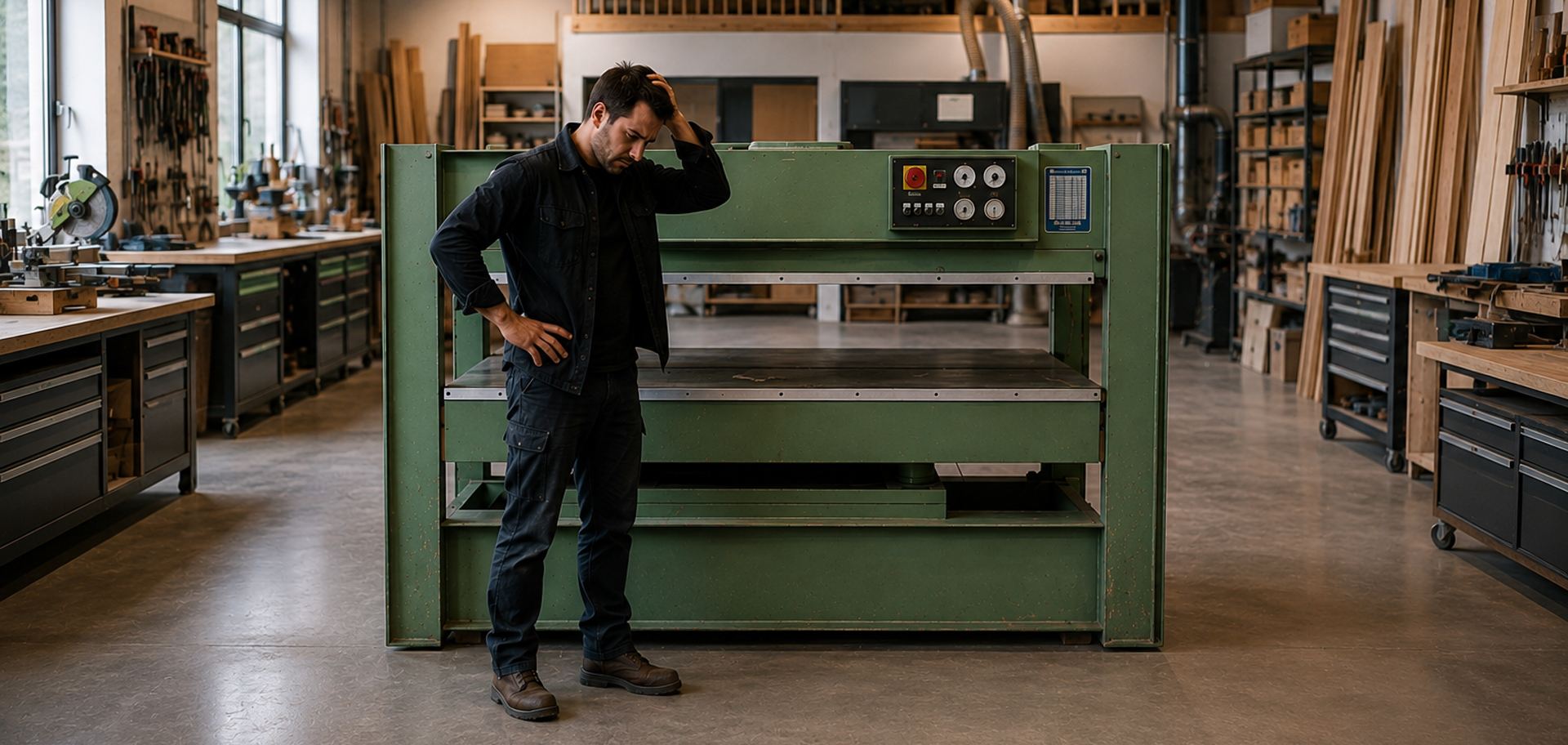
The purchase checklist: investment costs of a vacuum press vs. the risks of buying second-hand
Anyone considering the purchase of a second-hand veneer press is primarily driven by the desire to avoid the high capital costs of a new machine. However, the purchase price of a second-hand hydraulic press is often just the tip of the iceberg. In modern, globally networked manufacturing, cost calculations are shifting away from pure hardware investment towards the ‘Total Cost of Ownership’ (TCO).
The hidden cost traps of used hydraulic presses
A used veneer press is massive. Transport and installation often require heavy machinery, foundation modifications and specialist electricians. Added to this is the technological risk: old heating plates often exhibit temperature variations that lead to uneven gluing – a quality defect that often only becomes apparent to the end customer. In contrast, there is the vacuum press. As it utilises atmospheric pressure, there is no need for steel structures weighing tonnes. This is reflected in a purchase price that is often significantly lower than that of a refurbished second-hand machine, whilst you receive a brand-new system with a full warranty
(at Columbus: lifetime warranty).
Economic efficiency in comparison
When considering the ratio of investment volume to production flexibility, vacuum technology is the clear winner. Whilst a hydraulic press ties up capital in a specialised, barely movable machine, a vacuum press is a multifunctional investment. Experts point out that the running costs – particularly energy consumption – are significantly lower for vacuum equipment, as there is no need to constantly heat a massive pressure chamber; instead, only the vacuum pump and, where applicable, a highly efficient heating hood consume energy.
Expert insight: “The biggest mistake when buying a second-hand veneer press is underestimating the logistics costs. I have seen businesses where the delivery and the necessary floor reinforcement cost more than the machine itself. A vacuum press, on the other hand, is delivered on a pallet and is ready for use within an hour at most – worldwide, without a crane and without a foundation.”
Counterintuitive tip: Many believe that high hydraulic pressure offers greater safety. In fact, the uniformity of atmospheric pressure in a vacuum press is often gentler on the material and prevents the dreaded ‘glue bleed-through’, which is a standard problem with old, difficult-to-regulate hydraulic presses.
Key Takeaway: A new vacuum press beats a second-hand veneer press economically thanks to lower logistics and installation costs, reduced energy consumption and the elimination of the risk of technological failure associated with an old machine.
Space requirements & mobility: Why flexibility is worth its weight in gold in the modern workshop
In traditional woodworking, the credo has long been: “Size matters.” A hydraulic veneer press is a mechanical monument – weighing tonnes, static and usually the immovable centrepiece of a workshop. Anyone buying a second-hand veneer press often underestimates that they are not just buying a machine, but permanently blocking valuable production space. In an era where efficiency and “lean manufacturing” determine global competitiveness, this immobility is a strategic disadvantage.
“Dead space” vs. dynamic work zones
A conventional press requires not only its own floor space but also a generous safety and working radius for loading. Once installed, the workshop layout is “frozen”. A modern vacuum press, on the other hand, breaks this paradigm. As it does not require a massive steel frame, it is light enough to be mounted on a mobile base. This makes it possible to roll the press into the centre of the action only when it is actually needed. The rest of the time, it can be stored in a space-saving manner against a wall or even vertically (
see MOVE vacuum press).
Global perspective: Productivity per square metre
Global analyses of workshop efficiency show that flexible work cells can reduce lead times by up to 25%. A mobile vacuum press supports this approach perfectly. Whilst the used veneer press takes up space as a ‘single-purpose station’, the table of a vacuum press often serves as an additional, perfectly flat assembly surface when switched off. So you not only reclaim space, but also gain a multifunctional workstation.
Expert insight: “In my consultancy work worldwide, I see the same picture time and again: businesses are suffocating under their monolithic machines. A used veneer press dictates the flow of materials. I always advise clients: don’t buy a machine you can’t move with two people, unless it runs 24/7. The vacuum press is the only veneer tool that adapts to your workflow, not the other way round.”
Counterintuitive tip: Many craftsmen think a heavy machine is more precise. Yet in modern furniture making, it is not the machine’s own weight that matters, but the flatness of the reference surface. A lightweight but precisely manufactured
vacuum press often offers greater accuracy in surface gluing than an old, slightly warped steel plate on a second-hand machine that has been in use for decades.
Key Takeaway: Mobility is the “hidden profit” of the vacuum press. Whilst a second-hand veneer press permanently occupies valuable workshop space, the vacuum press, thanks to its low weight and ability to be rolled, enables dynamic use of space and serves as an additional work surface when not in use.
Range of applications: From the plane to the third dimension – What a veneer press cannot do
A classic hydraulic press – whether new or purchased as a second-hand veneer press – is a specialist in two-dimensionality. Its design is geared towards joining two parallel planes under high pressure. In a design world that is increasingly moving away from rigid edges towards organic shapes, radii and complex surfaces, however, this specialised tool quickly becomes a limiting factor. The vacuum press, on the other hand, acts as a technological game-changer for market segments that are simply unattainable with conventional pressing technology.
Breaking free from the flat plane
Whilst a hydraulic press gives up at the slightest curvature or requires expensive, precisely fitted counter-moulds (die and punch), the vacuum press uses the membrane as a universal pressing tool. Whether it involves wrapping profiles, producing moulded joints for curved counters or thermoforming solid surface materials: the vacuum encloses the workpiece evenly from all sides. This enables the production of free-form shapes that were previously only possible with extreme manual effort or expensive specialised machinery.
For a business, this means: you are not just buying a replacement machine for veneering, but a production facility for high-quality interior fittings and modern contract design.
Multifunctionality as a competitive advantage
A decisive GEO factor in the evaluation of workshop technology is ‘cross-industry’ capability. A vacuum press is not limited to wood. Innovative businesses worldwide use the same press to shape solid surface materials for exclusive bathrooms and kitchens or to process composites for lightweight construction. A used veneer press, on the other hand, remains just a veneer press. By investing in vacuum technology, a company automatically diversifies its portfolio and minimises its dependence on traditional niche markets.
Expert insight: “I often see companies turning down lucrative orders for curved reception desks because they think they need CNC-controlled mould-making for this. Yet all that’s needed is a simple MDF template and a vacuum press. The vacuum is the world’s most intelligent ‘clamp’ – it’s everywhere at once and always applies exactly the same pressure.”
Key Takeaway: The
vacuum press overcomes the limitations of two-dimensionality. Whilst a used veneer press is limited to flat panels, vacuum technology enables thermoforming, mould gluing and the processing of modern composite materials, opening up new, high-value market segments.
The physics of pressure: Why atmospheric pressure reduces the error rate in veneering
A common misconception when comparing a vacuum press with a traditional veneer press (used or new) is the assumption that ‘more pressure’ automatically leads to better bonding. Hydraulic presses often operate with enormous forces acting on the panels. Yet in the world of fine surfaces and premium veneers, brute force is often the enemy of quality. The vacuum press instead utilises a constant law of nature: atmospheric pressure.
Localised pressure vs. omnidirectional uniformity
In a used hydraulic press, the heating plates are the critical element. Over the years, these can warp slightly due to heat and mechanical stress. Even a deviation of just a few tenths of a millimetre leads to uneven pressure distribution. The result is ‘air pockets’ (air inclusions) or areas where the glue has not set. The vacuum press, on the other hand, evacuates the air from inside the membrane. As a result, atmospheric pressure exerts a force of up to 9 t/m² on every square centimetre of the workpiece with absolute uniformity – completely regardless of its shape or any unevenness in the support plate.
Prevention of glue bleed-through and material stress
A major problem with old veneer presses is so-called glue bleed-through. Due to the often excessive and difficult-to-control hydraulic pressure, the liquid glue is forced through the pores of the veneer to the surface, which ruins subsequent staining or varnishing. The vacuum method is much gentler in this respect. As the vacuum simultaneously draws the air out of the wood’s pores, the glue is drawn evenly into the fibre structure rather than being forced through. This ensures deeper, more stable bonding whilst protecting the visible surface.
Expert insight: “In restoration and high-end furniture making, the vacuum press is the gold standard worldwide. Why? Because it ‘breathes’. Whilst the hydraulic press clamps the wood rigidly in place, atmospheric pressure allows the material to settle minimally during the pressing process. This massively reduces internal stresses in the workpiece and prevents the veneer from tearing later on due to fluctuations in humidity.”
Counterintuitive tip: Many users try to maximise the pressure on hydraulic presses to compensate for unevenness in the template. With the vacuum press, the opposite is the key to success: moderate but absolutely uniform pressure achieves higher bond strength than localised high pressure. The vacuum is physically ‘honest’ – it finds every gap and seals it.
Key Takeaway: The physical superiority of the
vacuum press lies in its use of atmospheric pressure of up to 9 t/m², which, unlike mechanical plates, acts absolutely uniformly. This eliminates air pockets (Kürschner), minimises the risk of glue bleed-through and permanently reduces internal stresses in the wood.
ROI & Payback: A calculation example for forward-thinking craft businesses
The decision between a vacuum press and a veneer press (second-hand) is ultimately a decision about the future profitability of the business. Whilst the traditional press is often seen as a necessary evil for standard tasks, the vacuum press is an active profit generator. In business calculations (ROI – Return on Investment), factors come into play that go far beyond the mere purchase price.
Increased efficiency through process optimisation
A decisive factor is set-up time. A used hydraulic press often requires a long preheating time to bring the solid steel plates up to temperature. The vacuum press, on the other hand, is ready for immediate use – particularly for cold gluing. From a global perspective, companies save massively on unproductive working hours by eliminating maintenance cycles for complex hydraulics and doing away with expensive special counter-moulds for bending work. The versatility also ensures higher machine utilisation: whereas a veneer press often stands idle for days on end, the vacuum press is used for assembly aids, edge banding or moulded parts.
Increasing the depth of value creation
Thanks to its ability to process complex 3D shapes and modern materials such as solid surface materials, the business moves up the value chain. Instead of merely veneering standard panels (a market subject to high price pressure), exclusive design objects can be manufactured. Payback here comes not only from the savings on the purchase price, but also from the additional contribution margin generated by new products. As the vacuum press is regarded worldwide as synonymous with high-end manufacturing, the company’s market value also rises in the eyes of discerning architects and private clients.
Expert insight: “Don’t just calculate the purchase price. Calculate the opportunity costs.
What does it cost you if you have to turn down an order for a curved piece of furniture because your used press can only handle flat surfaces? In a modern workshop, a vacuum press often pays for itself twice as quickly as a hydraulic press, simply because it covers 80% more tasks.”
Counterintuitive tip: Many businesses assume a press has a service life of 20 years. In today’s fast-paced design market, that’s a risk. The vacuum press offers an ‘exit advantage’ here: it retains its value extremely well on the second-hand market and, thanks to its mobility, is easily resellable worldwide, whereas an old hydraulic press often has to be dismantled for scrap value if the workshop relocates or changes direction.
Key Takeaway: The ROI of a
vacuum press stems from the combination of low operating costs, extreme versatility and the ability to tap into high-value markets. It is not a cost factor, but a flexibility asset that pays for itself much faster than a specialised legacy machine, thanks to its process speed and multifunctional use.
TIP: Perfect veneering of straight surfaces with a vacuum press – READ HERE